We had some trouble recording the Bible Study in October, but there are the notes from the teaching. Enjoy!
What we Are
Named.Appreciated.Celebrated.Honored
Good Enough
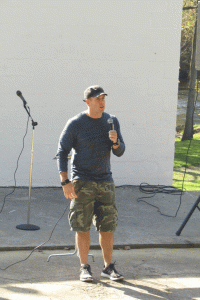
At the Cleona Playground for our service!


Kurt Vonnegut
I didn’t read one book in school. Usually, my grades were based on the accuracy of Cliffs’ Notes or a generous fellow student, who would attempt to give me a complete synopsis in the 3 minutes between classes, on the way to the test. My knowledge of Lord Of The Flies or 1984 was paper-thin and wouldn’t hold up to discussion, but was often good enough for a C-, which was more than good enough for me.
Everything changed when I withdrew from my second semester of college. I couldn’t tell you why I picked it up, (probably a girl) but the uninspired monotony of my rudderless existence was disrupted by Kurt Vonnegut, and Slaughterhouse-Five. At the time, it was impossible to know if I fell in love with books, that book, or the man that wrote it (as it turned out, it was all three), but I was certainly in love. I read everything he wrote, several times each, and of all the things I lost in the flood, that collection is mourned more than anything else.
Anyway, why do I tell you this? Because I’m reading the library’s copy of Slaughterhouse-Five now, and there’s this quote I wanted to share with you: (on human beings) “They do not love one another because they do not love themselves.”
Of course, this is a reference to a line from Jesus, “Love your neighbor as yourself.”
Mountains of sermons exist on loving our neighbor, yet we all-too-often don’t. The news is full of the many ways we do the opposite, our lives jammed with more examples of our failure to love our neighbors. So, why? Why don’t we love each other? Why do we judge and discriminate and ostracize and tear down and gossip and belittle and resent and withhold and control and wound?
I’m more convinced now than I was when I read it for the first time, that Kurt Vonnegut was absolutely right. The sermons we heard as kids when our parents forced us to sit in church, or from TV evangelists, was from 2 genres. First, way deep down, your primary identity is a filthy sinner. And second, straighten up and follow the rules, of which loving your neighbor was a big one. Is it any wonder we couldn’t (and can’t) love each other? We are trying to give away something we don’t have, instead of ‘out of the overflow of our heart.’ We are trying to put the oxygen masks on others before wearing our own.
Now, I do not shy from the subject of sin – grace is only truly understood with a knowledge of sin. But the story of us doesn’t start with sin, its first mention is in the 3rd chapter of Genesis. I didn’t start reading Slaughterhouse-Five at page 27, I don’t start Wonder Woman 20 minutes in, why do we do that with something as vital as the Scriptures?
Lately, our conversations in Nehemiah have focused on the promises, the gifts, the grace of God, hope and expectation, and living into our divine design (well, I suppose it’s not just ‘lately’). I don’t think the biggest problem for most of us is that we love ourselves too much, it’s quite the opposite – and the masks we wear of arrogance and self-obsession do little to conceal this fact.
Kurt Vonnegut’s books are wonderful, but they’re works of fiction. The Bible is the truth, and every word of it speaks to our worth, value, and identity. If we would only see ourselves as our Creator does, we could finally understand what it is to be loved, without reason or limit, and then, anything is possible. Everything is possible. Even loving one another.
How you do anything
Between here and there
Unless you can
What is the Quadratos?
Neither Do I
“How often the discovery of something new in the loveliness of the Lord Jesus has brought with it the discovery of some new corruption in our own hearts. . . . God will never plant the seed of His life upon the soil of a hard, unbroken spirit. He will only plant that seed where the conviction of His Spirit has brought brokenness, where the soil has been watered with the tears of repentance as well as the tears of joy.” (Redpath)
I remember, just after my son Samuel was born, on my knees, weeping, after failing again(!!!). My convictions had been exposed as soft and pliable, all too easily left behind. I was, yet again, not good enough. Not strong enough. A loser. Weak. Pathetic.
And it was here, racked with guilt, in searing heart-pain, overwhelmed by the darkness, that I had An Experience. One of the most profound experiences of my life, where God had broken through that pitch black in the most undeniable of ways.
And that’s really (sadly) the truth, isn’t it? My man Redpath, in the earlier quote, calls it, “some new corruption,’ and ‘brokenness,’ where my tears have drenched the soil and then (often only then) the beautiful flower of God’s grace sprouts, surprising me with persistence and unwillingness to let me sit in the dark alone.
This is the situation in Nehemiah 8. The people hear the Book of the Law, see that they’ve not kept their end of the deal (Now, today, of course, there’s no Law, no deal – only grace and love), and they feel their souls, collectively, crack. Their wailing creating the soundtrack to their lowest moments – like mine did. And, into that pain/that darkness/those tears, Nehemiah, Ezra, and the Levites (the clergy of the day) wade in with new commands – “This day is holy to the Lord your God. Do not mourn or weep.” And “Go and enjoy choice food and sweet drinks, and send some to those who have nothing prepared. This day is holy to our Lord. Do not grieve, for the joy of the Lord is your strength.” And, again, “Be still, for this is a holy day. Do not grieve.”
This is the message of the Scriptures. Whoever said it was primarily a book of sin and judgment is not telling you the truth. There is sin, but that’s not all it is, it’s not even the main idea!
Just like me, I am a sinner, but that’s not all I am, not what I am way down in the depths of my being. Down there, I am a child of God.
🙂
And when I start to think otherwise, when I’m on my knees starting to believe that I am a loser, pathetic, or not enough (of anything) – then God bursts through, fantastically, with a fresh word, with a message of joy, peace, and love. He picks me up, dusts me off, and tells me the same thing he told a woman in the middle of Jerusalem, “Where are your accusers? Didn’t even one of them condemn you?” … And Jesus said, “Neither do I.” Then, He says not to do it again.
And she/(and I)/we are new, the lights have been turned on, and we are set free – with the “joy of the Lord” as our strength – to actually not do that again. So we don’t.
 The Bridge Faith Community